Hi there! Because I’m getting tired of posting in two separate places, I’m going to only start posting on substack. Please follow me at buddhisttherapist.substack.com. Thanks for your support.
The End of Modernity and Individual Transformation

A few days ago I read a piece by Art Berman, an energy consultant and blogger. It’s trenchant, pessimistic, but clear-eyed piece called “Only Our Children will Cross the River.” I encourage you to read it. I believe it correctly diagnoses the predicament of modern technological society: overshoot, and the current and coming polycrisis we as a species are facing. Undoubtedly, modern human life is in decline. The signs are everywhere, from the rise of authoritarianism to massive, modern superstorms that we have never seen in our lifetimes.
I have no interest in relitigating his piece, but I encourage you to read it. But I’d like to highlight a section of it instead.
“Carl Jung might say that the West is in a mass psychological breakdown. The ego has cut itself off from the unconscious — our species-level memory. We’re trapped in ego-inflation and have lost touch with the soul. Jung wouldn’t recommend a new ideology. He’d tell us to reconnect to the archetypal, the symbolic, and sacred — or the breakdown will get worse.
McGilchrist, Kingsnorth and Hagens are cautiously optimistic that there is a way through the dilemma. I take the Jungian view. We must reverse a deep psychological disorder centuries — maybe millennia — in the making. That won’t happen without the collapse of the “old personality” of civilization, and that’s a psychological crisis that requires careful guidance.
Policy, technology, and information can’t cure a spiritual disorder. Climate change and overshoot are symptoms of Jung’s “psychic shadow.” The root is the belief that we are entitled to dominate nature and exploit the Earth without limit. Most people can’t—or won’t—let go of that belief.
Jung wouldn’t promise success. He’d say it depends on whether a meaningful minority chooses inner transformation over ego, power, and salvation through technology. The odds are low — but not zero. Historically, civilizations have been reborn by small bands who carried the flame through the dark, but it takes time, and we moderns are an impatient crowd…
Real change has always been — and will always be — psychological. People keep asking for a solution. Here it is. The Great Simplification isn’t just a response to breakdown; it’s the way forward. And like all true transformations, it begins from within.
I think Berman’s prescription for the next stage of humanity is the right one. We need to cure the spiritual disorder of modernity. How to do that is another question. As a first principle, I’d like to start with the Buddhist concept of emptiness. To quote a Lion’s Roar piece on the concept:
Emptiness means that all things lack—are empty of—inherent or independent existence. Neither we, other beings, nor any phenomenon in the universe has a permanent, separate, and independent core, soul, or identity. Nothing exists in isolation or on its own—everything is interdependent and exists only in relation to other causes and conditions. This includes physical objects, mental states, and the very concept of self.
At its core, emptiness means this, interbeing. It means that everything is built on the building blocks of the same energy and matter. On a very real level, we are all made of stardust. Nothing we can perceive— or can’t perceive— isn’t us. That we are separate is an illusion.
But most of us are unable to see it except for an occasional fleeting moment. Maybe it was a shroom trip in which you realized you were not separate from the flowing trees dancing and shivering in the wind. Maybe it was a sunset where your thoughts stopped suddenly and just for a moment you had a sense of inner peace and nothing mattered but the moment you were in, the so-called satori moment in Zen. But ultimately consciousness returns to a sort of narcissism that humans are plagued with, that you are the center of the universe and your feelings and thoughts are the most immediate and important. That this narcissism is actually a lie– i.e. you aren’t the center of the universe and there are 8 billion people like you with their own hopes, dreams, thoughts and feelings– is somehow immaterial to most of us.
Everything, however, in our modern culture reinforces this self-centered notion. I live in the East Village on the island of Manhattan, which if you’ve ever been here is a smorgasbord of young, counterculture life (although the tech bro life has invaded it more and more in the last few years). Here one can see the seeds of modern egocentric life, thousands upon thousands of young people with tiny computers in their hands, broadcasting the importance of their lives to the world around them through their social media apps, dressing in either the latest clothes or rebelling against them. Everyone seems to want to be important, to stand out, to be noticed in some way. On any given day, I will see influencers taking pictures in front of the new hot place.
(I’m reminded of Rilke’s Ninth Duino Elegy:
But because being here is much, and because all
that’s here seems to need us, the ephemeral, that
strangely concerns us. We: the most ephemeral. Once,
for each thing, only once. Once, and no more. And we too,
once. Never again. But this
once, to have been, though only once,
to have been an earthly thing – seems irrevocable.)
There is no judgment of this dance, this expression of life and individuality. (The irony of course is that because of the ubiquity of culture, individuality becomes conformist in a way, our culture flattened to a nice tech sheen). But I do wonder how much real peace any of these young people have. I’ve added more and more Gen Z young adults in my therapy practice in recent years, and there’s a common theme in all of them, the general sense of inadequacy they feel.
My sense is that they are spiritually hungry but have no outlet to express their spiritual natures. Everything in our modern world has reinforced the notion that they are special, individual beings that must acquire more and more to feel safe and loved. They must do everything to be their most successful and attractive versions of themselves and if they are not those things, they are doing something wrong. Everything in my therapy practice tries to reverse the flow of this way of being, as I’ve told them all, there is nothing wrong with any of them, they are lovely and worthy of love just as they are. Of course none of them really believe me, and I’m fighting a constant uphill battle. It’s hard to fight the tide of any entire society and way of being.
On one level, I try to reinforce to them that their growth isn’t about acquiring more and more achievements and power and safety until nothing can hurt them, mostly because that is an impossibility. I try to reinforce that their growth is about learning to slow down, let go and reconnect to the world around them, especially the natural world, to reconnect to their bodies and the present moment, to the impermanence and beauty everything around them. .
Healing comes not from adding, but from subtracting, about finding quiet in one’s inner self, about seeing yourself and everyone just as it is without the projections of the self, to accept that we are mortal, we will die, that this life is it, that in the end what we need is calm, quiet and connection.
In my imagined, utopian world, I see a vision of something different than what we have today. I imagine a world where we all had the space and time to look inward, because how few of us do?
What might that look like? Two hours of reading, introspection, and meditation early in the morning. Work comes next whatever that means in this fake society I’ve created. But work that is less alienating than our current form of work, work that is connected to our survival and purpose as biological creatures. It amazes me how divorced everyone is from this. And then time spent with people we love. This is a world not of endless growth but of presence and love and making time for our pain and grief.
I know this will not happen as a society. But I think individual transformation is possible. It takes a long time… I think that’s ok because everything worthwhile is difficult. We all need guides along this journey; a therapist with this perspective would be helpful. If it’s not available to you, then I suggest seeking out the masters of Western and Eastern thought. There are thousands and thousands of profound, beautiful books that can start to change you.
But even if you won’t or can’t do any of that, we can always just slow down, breathe and take in the moment… connecting to the sense that everything is always changing, that this moment is profound and beautiful, and that we can pay attention to this profundity at any time if you’re willing.
What Is This? Learning to Find the Sacred in the Mundane
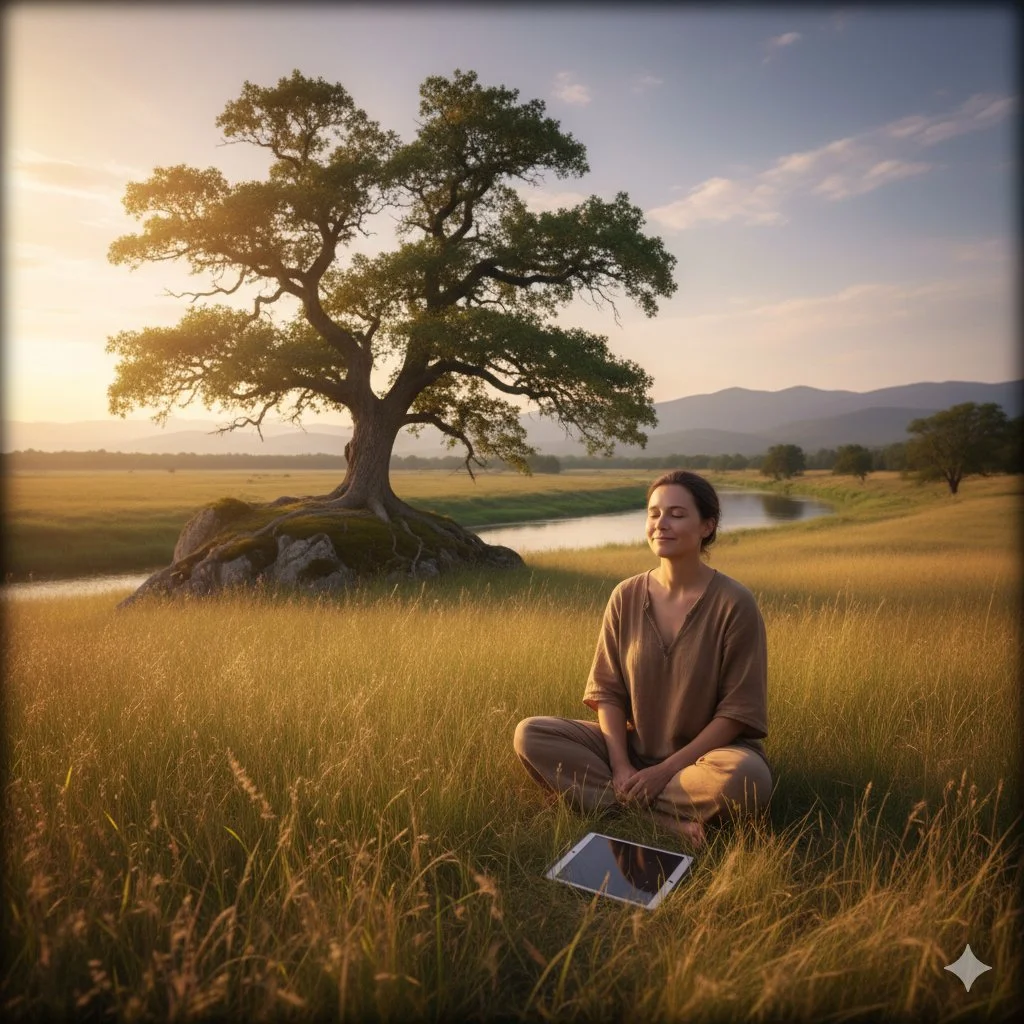
What is this? In some Zen traditions, it is the most profound of koans, begging the practitioner to contemplate not on a rational level but a quieter, intuitive level the nature of each moment as it is.
I can’t really answer this question in a satisfying way because language is inherently limiting when explaining reality ... Nonetheless I’m going to give it the good old college try for a second.
What is this? Is not trying to explain a moment with words. If I did that, it might sound like “I’m sitting in the living room, writing and listening to the piano, while my wife and dog sleep in the other room. That’s what this is.” Sure, that’s an answer, but it misses the point.
What is this? This is silence. It is the unfolding of the universe. It is change. It is chaos. It is structure. It is the movement of life and death, growth and decay, that has gone forever and will continue to go on long after humans leave the earth.
It tells me my little human life, this “I” doesn’t mean a whole lot in the end, at least in the Western way of conceiving identity. My legacy is hogwash. Even if I somehow end up extremely rich and famous, almost no one will know I existed in 200 years.
The temptation from a rational, Western point of view is to go nihilistic, believing that my life is meaningless so I might as well extract as much pleasure as I can from it.
However, at least the way I see the world, that belief would be wrong. Life is meaningful because we are here. Every moment is sacred, even the mundane moment right now, as I type on my cracked iPad and write this inane post that no one is going to read.
When you learn to let go and log off— which admittedly is increasingly impossible in a world that steals your attention left and right— you can actually be here. Most of us are in doing mode, thinking and managing our lives through the prism of productivity and getting things done. So few of us are just being.
In the end, the most profound spiritual wisdom I know of is this: there is nothing to do. The world is enough as it is. You are enough as you are. Let go. Be here. It’s all so much more lovely than you realize.
Or to quote one of our great poets, Mary Oliver:
I don't know exactly what a prayer is.
I do know how to pay attention, how to fall down
into the grass, how to kneel down in the grass,
how to be idle and blessed, how to stroll through the fields,
which is what I have been doing all day.
Tell me, what else should I have done?
Doesn't everything die at last, and too soon?
Tell me, what is it you plan to do
with your one wild and precious life?
We're All Just Commodities In the Modern Economy

A thought occurred to me as I scrolled my Twitter feed, then clicked on the Candy Crush knock-off game I play too much, and then on a YouTube video. While I may feel like a living sentient being with human feelings, in a very real way to the modern economy I am treated first and foremost as a commodity.
In Tricycle Magazine Against Perfectionism (or How to Enjoy Being a Fuck-Up)
Against Perfectionism Or How to Enjoy Being a Fuck Up
Perfectionism is a disease among my patients. People’s inner dialogues these days are unrelenting. The oddity of this all is that the more perfect someone might seem on the outside, often times the more broken they are on the inside. (Of course, this isn’t everyone by any means). It takes a ceaseless, judging superego to maintain the veneer of perfection to the outside world, and any sort of crack in the crevices of one’s soul proves that one is messing up.
I ask myself often: why are so many suffering from this perfectionism? There is no doubt that perfectionism is a defense, but a defense against what? Well like a lot of defenses, perfectionism begins in childhood. Even supposed good parents are not immune to pushing their children to achievements and praising someone for what they do. Even the statement, “I want you to be happy” is an imperfect one to say to a child. You might say I’m picking nits here, how can saying you want your child to be happy be imperfect parenting? It’s simple, saying you want your child to be happy, implies that if a child doesn’t feel happy, then there are doing something wrong. Subtleties like this can lead to a more judging mind. I suggest an alternative: telling a child that it’s ok to feel whatever they feel, allowing them to express who they are, and then going from there.
Our society is another reason perfectionism reigns supreme. The truth is in the modern economy we are in competition. Capitalism breeds it, encourages it. The free market, according to some, is a meritocracy, and those corporations or people who are unworthy get weeded out. To put it another way: only the strong survive. Whether we realize it or not, this is embedded deep in the American psyche. As a result, we naturally feel competitive with our peers. I can’t tell you how many of my patients cannot celebrate the successes of their friends and peers, how it inevitably makes them feel jealous.
Social media as we know encourages this competition as well. The rise of influencers is an extreme example of this, people paid to show a fantasy lifestyle that in no way resembles reality, but unconsciously gives up an example of what life should look like even if reject what we’re seeing. It’s sort of like junk food. Sure, in small doses it's fine, but eat it every day, and you start to feel sluggish. On a more subtle level are the more prosaic everyday social media posts, the reels, the photos of your friends having fun. This can be a good thing, to see what people in your life are up to, but again like junk food, if you consume it constantly, it will start to have effects, which you probably aren’t even aware of, creating expectations of what life should be. (I try to encourage patients to consciously consume social media, even following therapy-like accounts which encourage self-reflection).
A person who is well-adjusted in my opinion has nothing to do with a so-called perfect life. It is the person who can accept their life and their feelings just as they are. Every moment is a chance to awaken our hearts just a little more, to grow with self-love and compassion for ourselves. Inevitably if we can give ourselves self-love, it eventually extends out to all the people in our life.
It is important to define what “self-love” is, however. It is not the praise of our parents or society for “doing well” or “achieving.” It is not the easy victories of vanity, of being beloved by the outside world. Those things feel good, of course, but if one’s self-esteem is built on that, one’s self-esteem inevitably collapses when that is taken away. Self-love means letting yourself fuck up and embracing that. It is a kind and gentle attitude towards one’s self. It means allowing ourselves to feel whatever we feel without judgment, but with love and attention. When we allow this something happens, we can feel actual joy for life. As I’ve said before, “doing” stops being the lens we see the world. We can just be, just as we are, imperfect beings of light.
The Wisdom of Boredom: Finding Creativity and Spirituality in the Age of Facebook

A recent observation: we are a society that hates boredom. After all, why be bored when we have so many entertainment options? If I am in a long line at the post office, I could stand there doing nothing, waiting patiently for the slow, tortoise line to move an inch. Or I could look at my phone and connect to a million entertainment options at the touch of a fingertip.
I can listen to music, a podcast, watch a movie on Netflix or Hulu or Amazon or Disney+ or stream a video on Youtube or stream a live sporting event or play a game or read an article or check my social media accounts. All of these options make the time fly by so we don’t have to face the monotony of everyday life. And everyday life without these options can be incredibly boring. I’ve observed with many of my patients that they use screens and entertainment constantly because they are afraid of aloneness, of boredom, of being alone with their thoughts. They will use anything to escape that feeling because underneath it all they are afraid. I can certainly relate to this, especially if you’re feeling depressed or anxious. Who wants to live in the purgatory of the depressed or anxious mind?
But something is lost in a society that needs to constantly be stimulated. As others have suggested boredom is essential to creativity. I think about writing right now, typing on my computer. How did I come up with the idea to write this? I sat on the subway yesterday on my ride home. Usually, I would do a crossword puzzle or read a book. But yesterday I just sat there with nothing to do. I tried to meditate, stay with the moment, but as it is wont to do, my mind began to drift. Before I knew it I thought this blog and started thinking about ideas, and I found myself reflecting on my boredom. And now I am here typing this article.
Of course, nothing about what I say is groundbreaking. There are countless stories of artists using boredom for their creativity. I think of one of my favorite poets, Frank O’Hara. While he worked at the MOMA in the 1950s, he wandered midtown Manhattan during his lunch, as a way to stimulate his creativity. He could have searched for easy office pleasures and chatted with someone or read a magazine. But O’Hara knew that he needed his mind to wander in order to make connections for his poems. During his walks, he had no headphones or iPhones, or any other distraction because they had not been invented yet. He just walked and observed and wrote some beautiful poems. (“Steps” in particular is a favorite of mine). Of course, it could be argued that Midtown Manhattan is anything but boring. But I think that misses the point. Creativity needs a large meadow for the sheep to roam. Enclose the space of the mind too much, and we lose something.
And as many poets have suggested boredom could be viewed as a deficiency in how we see the world. As Rilke once said, “If your daily life seems poor, do not blame it; blame yourself, tell yourself that you are not poet enough to call forth its riches; for to the creator there is no poverty and no poor indifferent place.”
There is much truth to this. I am often amazed at how often people miss the wonders of existence. Trees, for example, have become holy to me, windows into the divine spirit right before eyes. I don’t see them that different than a church. They are temples in themselves. They have their own organic, harmonious beauty, breathing and growing and dying all at once. I have spent many any afternoon, staring at the barks of trees, the structure of branches, the gentle, undulating fall of the leaves to the ground in autumn. There is a divine dance happening here, that I feel blessed to witness.
I realize that this is quite a sentimental view of trees. I can hear someone one of my friends in my head saying, “dude, they are just trees.” On one level that’s right. But on another level, maybe the spiritual is right in front of us and we miss it because we are too busy being entertained and not being bored. Maybe we are too busy running away from our feelings and our senses for easy pleasures. I say this without judgment. God knows, I spend too much time on my phone and watching television. But I also need to reset and be mindful of the wonders of existence. If I don’t, the days fly by without any real joy or connection. And what is life without those things?
How the Concept of Impermanence Can Help Anxiety-Ridden Millennials

I wrote something for Tricycle magazine! An excerpt to the beginning for you to peruse:
During a lecture, a student asked Shunryu Suzuki, the Buddhist priest who helped bring Zen to America, if he could sum up the Buddha’s teachings in a nutshell. To everyone’s surprise, Suzuki answered. “Everything changes,” he said. It was as simple as that.
On a rational level, we all know this. Seasons pass, the lush leaves of spring transform to the vibrant, dying foliage of autumn. People grow older, wither with time, and pass away. On my New York City block, a new building stretches up to the sky where an old one sat just a few years ago. All of it is a part of the flow of life. “Everything changes.” Life is impermanent.
How to Break Through Our Neoliberal Selves

Just a quick post, I wrote something for Mental Hellth, a newsletter about mental health and capitalism. The full version is only available to subscribers! Enjoy.
One Thing You Can Do Everyday To Feel Alive

This blog can definitely veer into mystical or weird, which I hope some of you find interesting. But today I would like to focus on a practical thing you can do daily every day. I don’t know what your morning routine is like. Maybe you have children and most of your morning is filled with activity, and you don’t really have a second to breathe. Or maybe you’re a later riser, and you stumble out of bed right into the workday. That can be a taxing way to live. Living this way means to enter the day without any reflection. And before you know it, the days, months, and years pass, and you haven’t done much reflection at all about your life.